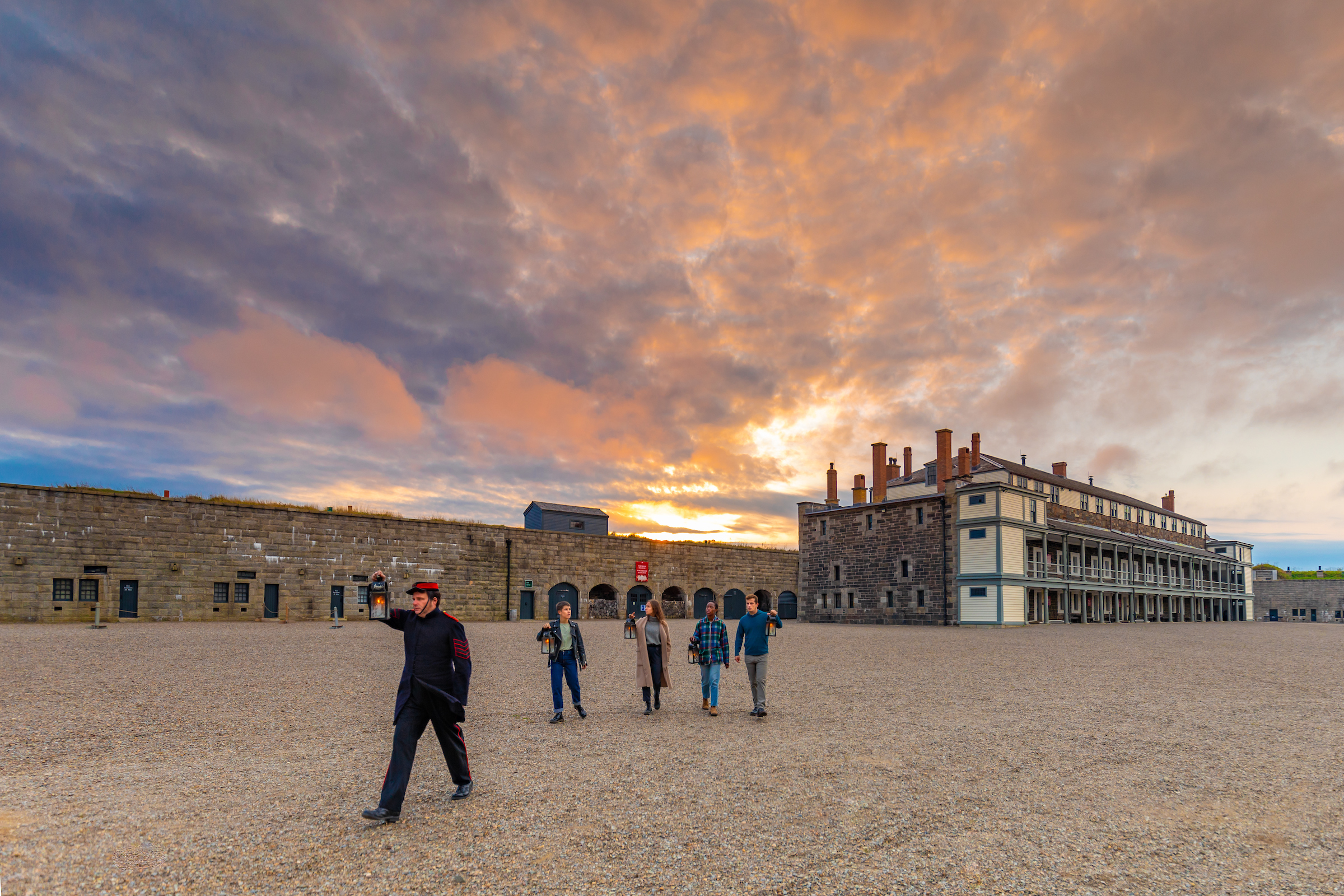

Perched over the city, the Halifax Citadel National Historic Site is a cultural landmark and a gateway to understanding Canada's military heritage and Halifax's history.
What to See and Do Here
Explore the Citadel’s newest exhibit, Fortress Halifax, A City Shaped By Conflict. The exhibit conveys the experiences of diverse groups including the Mi’kmaq, Acadians, African Nova Scotians, British colonists and soldiers, and war refugees.
Leonard Paul’s art greets you as you enter the exhibit and captures the essence of Kjipuktuk (Halifax) before colonization. Meanwhile, the interactive One Land, Four Peoples touch table allows users to explore a map of the region that reveals a different map layer depending on whether they choose a Mi’kmaw, Acadian, French, or British cultural lens. Building on these perspectives, the exhibit delves into Mi’kmaw heritage, the evolution of the Citadels, and Halifax’s role in global conflicts.
Uncover fascinating stories, from the Jamaican Maroons who were vital in building the third Citadel’s defences to the hometown heroes who made remarkable contributions to Canada’s war efforts. Continuing the informative and immersive experience, listen to and watch first-person perspectives recounted by those who shaped Halifax through interactive screens.
If you’re looking for some fun, step into soldier tents, try on uniforms, and even dress up as a Royal Artillery member.
Those seeking a low-key activity can sit and watch “A Harbour Worth Defending”, a captivating 15-minute film showcasing Halifax’s importance as a British and Canadian naval base. The film provides an engaging overview of the city’s strategic importance through the ages, giving visitors a chance to rest while immersing themselves in the region’s rich history.
Once you’ve finished viewing Fortress Halifax, journey through the site and discover nine fascinating period rooms. Step into the barracks to get an authentic glimpse of a soldier’s daily life in 1869, complete with the beds, blankets, and living quarters that once housed hundreds of soldiers.
After exploring the barracks, dive into the life of a soldier on the hill. Recognizing the importance of education, Queen Victoria introduced schoolrooms to ensure soldiers were better equipped with knowledge and skills. This initiative improved their service and prepared them for life beyond the military, a legacy showcased in the Citadel’s School Room.
The School Room now serves guests with an engaging experience. It presents maps of the 1860s and a unique education environment reflective of its time.
Following your visit to the School Room, head to the Shaping the Hill exhibit to learn about the fascinating construction history of the four Citadels. Visitors can navigate interactive displays and a descriptive virtual tour of a scale model of the star-shaped fortress, highlighting the impressive engineering behind these forts.
As noon approaches, the thunderous cannon fire is a must-experience event. Make your way up to the ramparts to watch the expert loading and firing of the massive cannon. The powerful boom resonates across Halifax at noon every day as a reminder of the Citadel’s historic defence.
While you’re up on the ramparts, check out the signal masts and learn how they were once utilized to send over 400 different coded signals down to both Halifax’s citizens and to the other forts that protected the harbour.
Before concluding your visit, stop by the Army Museum to delve into military history through photographs, artifacts, and exhibits such as The Road to Vimy and Beyond and The Trail of the Canadian Army, which trace Canada’s contribution to the world wars.
Plan Your Visit
Tickets
- Purchased on-site. Free admission from June 19 to September 7 for 2026.
What to bring
- Dress for the weather (conditions vary by season).
- Comfortable walking shoes.
- Noon cannon fire is loud—ear protection recommended for sensitive ears.
Getting there
- Parking is available at the top of the hill, though limited. You can take transit and be let off nearby and walk up or find street parking or a parking garage.
- Take your time walking up and read informative plaques about the Citadel’s strategic role.
Other things to know
- There’s fewer activities from mid-November to May, but visitors can still explore Parade Square and see the noon gun. Ramparts may be closed if conditions are slippery.
Local Tips
Take a break at the coffee bar and enjoy lunch or a drink. For a more unique experience, you can join a candle-lit or ghost tour, or try spirit tasting.
On the walk up, take your time and read informative plaques about the Citadel’s strategic role. Don’t miss the south and north viewing points along the road that encircles the Halifax Citadel for panoramic views.
Should Know
-
AccessibilityWheelchairs and walkers are available in the Visitor Information Centre. The grounds, main floor of the Cavalier Building, Army Museum, most exhibits, and washrooms are all wheelchair accessible. Accessible parking is located at the front entrance/exit near the front entrance kiosk. Free entry for support persons. Service animals are welcome in the company of their handlers. Please keep your service animals on a leash or harness at all times during your visit. A Harbour Worth Defending (film) has open captioning.
-
DurationAllow for 2 hours to explore the site.