X
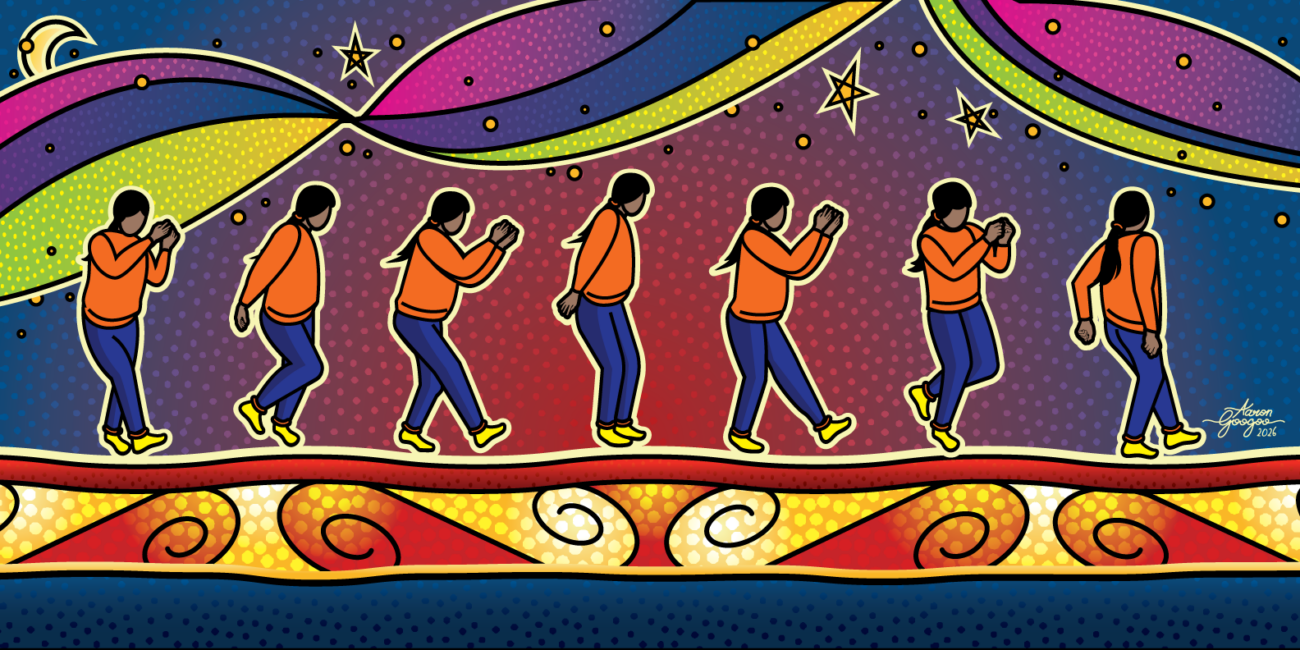
The Ko'jua is one of the oldest dances of the Mi’kmaw people. It is a very special dance that belongs only to them and is still enjoyed at Mi’kmaw gatherings today. It has very few steps, making it easy to learn. Dancers express themselves wearing colourful and uniquely designed regalia, sharing stories through their movements.
Depending on the style and family connection of a specific Ko'jua dance, the movements focus on swinging arms and shuffling legs, helping the dancer weave the story being shared.
Dancers tap or stomp the ground three times with one foot while moving forward, then do the same with the other foot. At the same time, both arms swing together, as if using ski poles. These movements repeat as everyone dances in a circle while one person leads the song. The song can tell many stories.
The Ko'jua dance is shared at many important moments. These include Mi’kmaw community gatherings called a Mawi’omi (also called a powwow), as well as births, deaths, coming-of-age celebrations, community hunts, elder gatherings, and Wi’kupaltimk, which is the Feast of Forgiveness.
Music of the Ko'jua
A Ko’jua dance includes a song. The song is played using a Ji’kmaqn or a drum made from natural materials such as wood and animal skin, typically deer or moose hide. The Ji’kmaqn is a special Mi’kmaw instrument made from black or white ash trees. The wood is pounded with heavy rocks to create thin, flexible strips.
When the Ji’kmaqn is slapped on a hand, palm, or thigh, it makes a loud and distinctive sound. A hand drum can also be used. Long ago, the Ji’kmaqn was used to make noise to scare wild animals away from camps.
There are about fifteen Ko’jua songs that are well known in Mi’kma’ki. These songs are hundreds of years old. Some families have protected these songs and passed them down through generations. These Ko’jua dances also tell family stories, as some reflect a family’s connection to an animal or bird. For example, if your family is from the fox clan, your Ko’jua dance would emulate a fox moving as it hunts.
Many inspiring stories tell how people learn to become dancers. The Ko’jua teaches people to celebrate one another and welcome others into the community. The Mi’kmaw people are proud of the teachings passed down by their ancestors.
By keeping these traditions alive, families and communities help future generations feel the same pride and sense of belonging that comes with being Mi’kmaw.
Words to Know
Ko’jua (Go-jew-ah):
A fast traditional song and dance of the Mi’kmaw people. It is typically danced in a circle and shared at gatherings and celebrations.
Regalia (Reh-gay-lee-uh):
Special clothing worn during dances and ceremonies. Regalia is colourful and meaningful.
Mawi’omi (Maa-wee-omh-me):
A gathering or celebration of Mi’kmaw people. Powwows are a type of Mawi’omi.
Ji’kmaqn (Jee-ah-ma-khan):
A special Mi’kmaw instrument made from ash wood, known for its pleasant aroma. It makes a loud sound when slapped and is used for music and rhythm.
Wi’kupaltimk (Wee-goo-bahl-timk):
The Feast of Forgiveness, a special gathering where people share food, stories, and teachings.
Special thanks to NSITE’N and Sunshine Paul-Martin for their support in the creation of this content.
Illustration by Aaron Googoo.